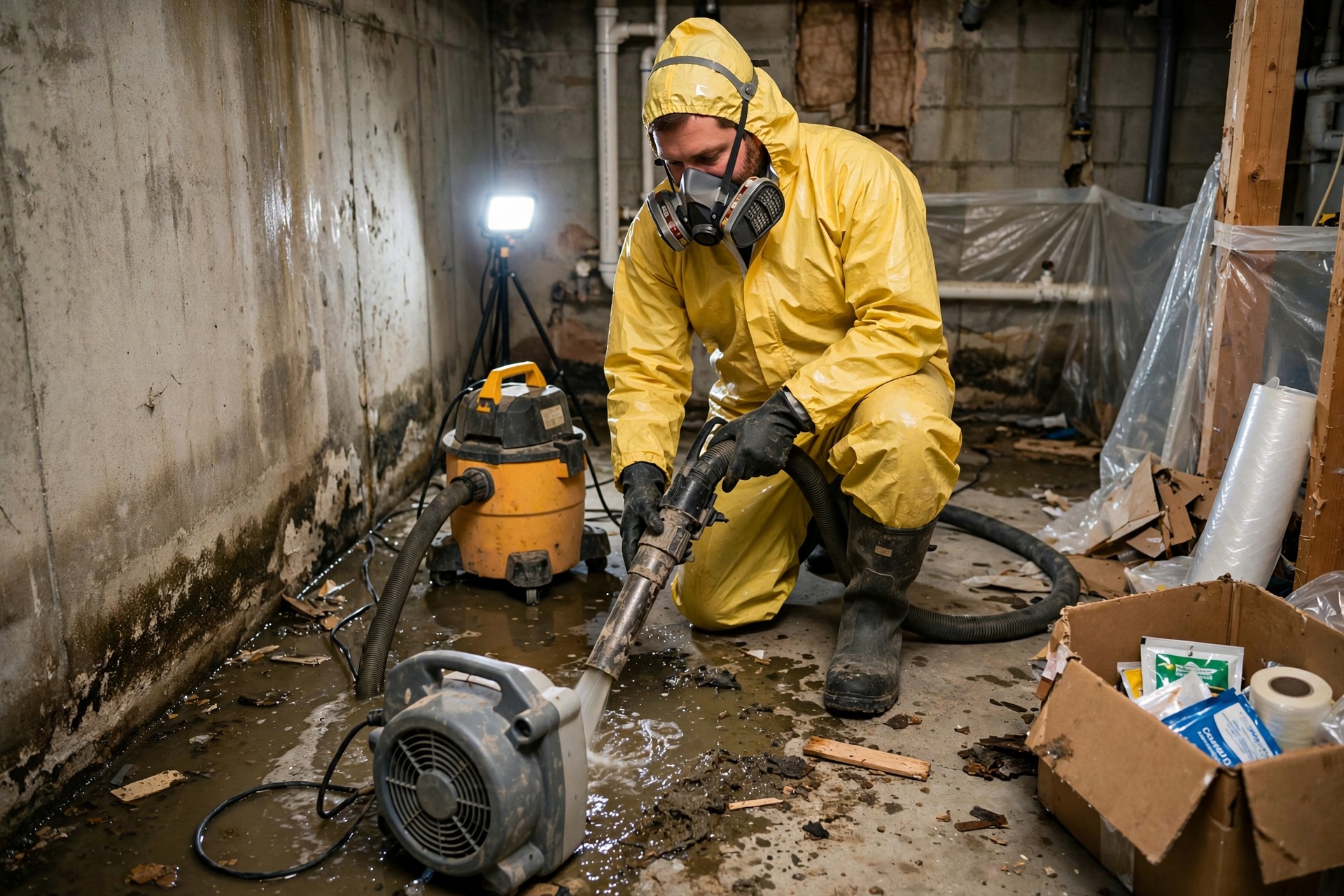
Kearns homes built from the 1950s through the 1970s often have cast-iron or clay sewer lines that crack under shifting clay soils common in the Salt Lake Valley. When a main line backs up, sewage can migrate under slabs and into finished basements, saturating particleboard subfloors and drywall. Crews must remove baseboards and drill weep holes to confirm moisture has not wicked into wall cavities before any drying begins.
Winter freezes in the Kearns area frequently cause pipe bursts where lines run through unheated crawl spaces or along north-facing foundations. Once temperatures drop, standing water mixed with raw sewage creates ice lenses that trap contaminants. Restoration requires controlled thawing followed by negative-air machines to prevent aerosolized particles from reaching living spaces above.
After extraction, technicians test moisture in concrete slabs using pinless meters because Kearns soil retains water longer than surrounding bench areas. If relative humidity stays above 60 percent for more than 48 hours, secondary mold growth on joists becomes likely. Air movers and dehumidifiers are staged on the same day to stay ahead of that timeline.
Technician insight
In Kearns, the thing that catches most people out with water damage and sewage restoration is how quickly clay soil under 1960s slab homes holds moisture after a winter backup. Homeowners often stop at visible floor cleaning, but if we do not pull baseboards and run negative air for at least three days the smell returns through the slab joints every spring thaw.
Kearns Basement Backup After Freeze
A main line froze and burst under a 1964 Kearns rambler, sending sewage into the finished basement. Extraction removed 400 gallons, then moisture mapping found water under the slab. Three days of drying and antimicrobial application restored the space without mold growth.
Water Damage & Sewage Restoration Services We Offer
✓Basement Sewage Extraction
Removes standing sewage from Kearns basements and disposes of contaminated water at approved facilities before any drying equipment is placed.
✓Slab Leak Sewage Cleanup
Locates and extracts sewage that has migrated under concrete slabs common in older Kearns neighborhoods, then dries the sub-slab area to prevent hidden mold.
✓Crawl Space Contamination Removal
Clears raw sewage and silt from crawl spaces beneath Kearns homes, followed by antimicrobial treatment of joists and vapor barriers.
✓Emergency Water Removal
Provides 24/7 extraction of sewage-tainted water from kitchens, bathrooms, and utility rooms after backups in the Kearns area.
✓Structural Drying After Sewage
Uses commercial air movers and dehumidifiers to dry saturated framing and subfloors once visible sewage has been removed from Kearns properties.
Water Damage & Sewage Restoration Cost in Kearns, UT
| Service | Typical Range | What Affects It |
|---|---|---|
| Initial Assessment | Free | During 24/7 emergency response |
| Sewage Extraction | $800–$2,200 | Varies with gallons removed and access |
| Structural Drying | $600–$1,800 | Based on number of rooms and equipment days |
| Antimicrobial Treatment | $350–$750 | Required for porous materials in contact with sewage |
Ranges are typical for Kearns, UT and confirmed with an exact written quote before any work starts.
How it works
- 1
Arrival and Safety Setup
Technicians arrive in Kearns within the hour, establish containment, and test for electrical hazards before any extraction begins.
- 2
Extraction and Disposal
Standing sewage is pumped into sealed trucks and hauled to permitted treatment sites while solid waste is bagged for proper disposal.
- 3
Moisture Mapping
Infrared cameras and meters locate hidden moisture in walls, floors, and under slabs typical of Kearns housing stock.
- 4
Drying and Sanitizing
Equipment runs until readings meet industry dry standards, followed by EPA-registered disinfectants on all affected surfaces.
Pricing
Costs depend on volume of water, depth of contamination, and square footage affected.